News

featured-image

Photo: Collected

Hoi An is an ancient town with long-standing cultural values. This place also possesses many poetic landscapes and attractive entertainment spots that are not inferior to Da Nang. If you don't know where to go in Hoi An, these 20 enchantingly beautiful Hoi An tourist destinations will give you an idea to explore.

In the previous section, we learned about some tourist destinations in Hoi An that are worth experiencing. This section will introduce to you tourist destinations that you should not miss when coming to Hoi An, as well as reveal to you some tips for a complete trip to Hoi An.

20 Hoi An tourist destinations that tourists should experience (part 2)

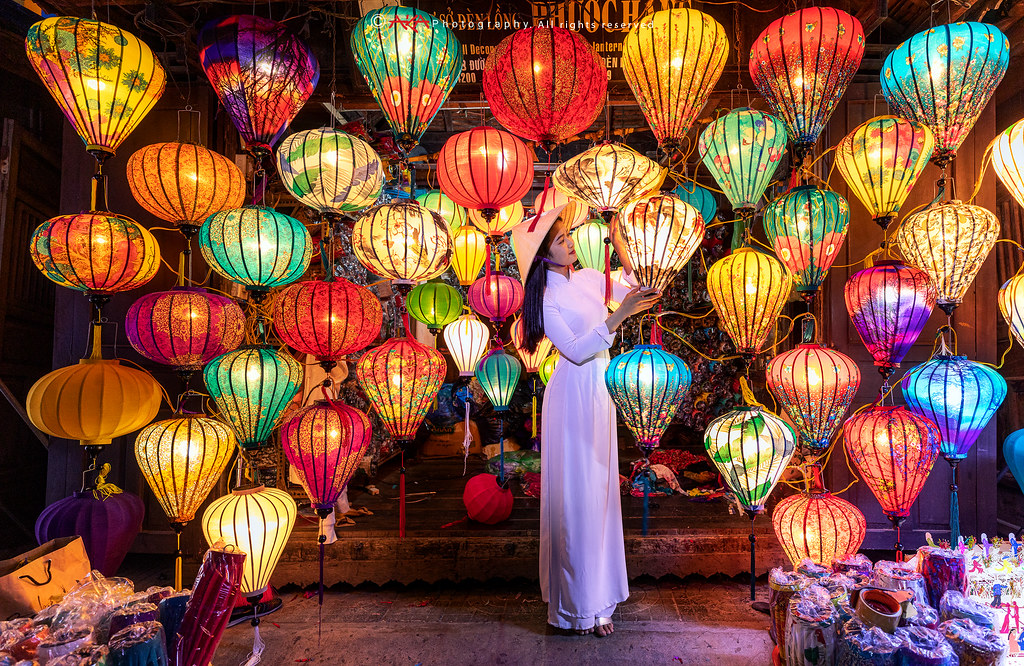
9. Lantern Street - sparkling check-in point

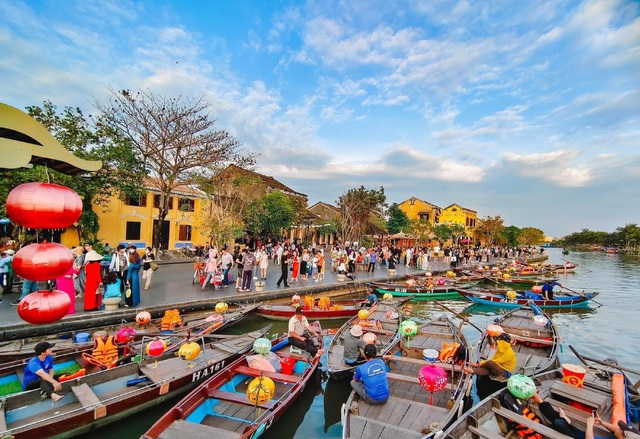
The colorful lanterns shining brightly in every corner of the sky have become an image associated with the old town every evening. No matter what time you come here, visitors can always admire the beauty of lanterns hanging everywhere.

Tourists coming to Hoi An are always delighted with the brilliant lanterns

Hoi An Lantern Street has become a famous check-in spot. Most tourists, especially young people coming to Hoi An would love to visit this street to admire the beauty and take photos.

Address: Nguyen Phuc Chu Street, Hoi An City.

10. Chaozhou Assembly Hall - Unique work of the Chinese people

For tourists who are passionate about exploring culture, Chaozhou Assembly Hall is an ideal destination. Chaozhou Assembly Hall, also known as Am Bon Pagoda is not only a place of belief and spirituality but is also where the Chaozhou community in Hoi An meet.

Currently, the hall is worshiping gods who control waves and winds. According to people here, if you pray sincerely, your sea trips will always go smoothly.

Address: 157 Nguyen Duy Hieu, Hoi An City

11. Ba Mu Pagoda

Dubbed the holy place of "million-like posts", Ba Mu Pagoda is constantly "hot" when young people rush here to check-in. With its elaborately carved golden wall and the clear lake surface reflecting the deep blue sky, everything is set up perfectly for taking pictures.

Not simply a place to take photos, Ba Mu Pagoda is also one of the famous relics that plays an important role in the spiritual life of local people and is considered a new symbol of Hoi An.

Address: 675A Hai Ba Trung, Hoi An City.

12. An Bang Beach - 1 of the 50 best beaches in the world

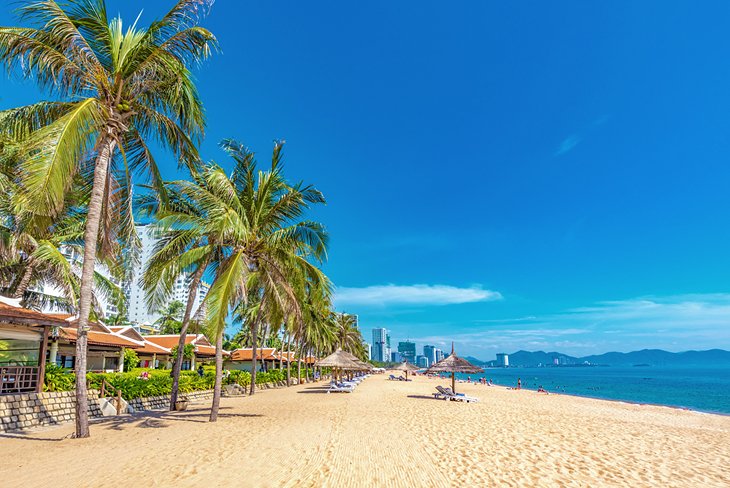
Hoi An tourism, in addition to heritage sites and ancient buildings, also has beautiful beaches. One of them is An Bang Beach. Located only about 3km from the old town center, An Bang is on the list of 50 beaches in the world.

Hoi An also offers enchanting beaches

With a length of only about 4km, but with pure nature, diverse vegetation, fine white sand, and clear blue water, this place is very suitable for beach trips and relaxation.

Address: Hai Ba Trung Street, Hoi An City.

13. Hoi An Folk Culture Museum

The Folklore Museum is a unique thematic museum in Hoi An, opening to serve visitors starting from March 24, 2005. This museum consists of 2 classical floors.

Inside, 490 artifacts are displayed with a variety of topics: folk art, performing arts, traditional professions, etc. Through this, visitors can better understand the process of building and developing Hoi An.

Address: 33 Nguyen Thai Hoc, Hoi An City

14. Tan Ky ancient house - National Cultural Heritage

Aged more than 200 years old, Tan Ky ancient house has been classified as a national relic. This house possesses unique architectural features with a blend of Japanese, Chinese, and Vietnamese architecture.

Hoi An has quite a few ancient houses and Assembly Halls worth a visit.

Built from traditional materials with many interconnected folds and many delicately carved miniatures and shapes, the houses still retain their old beauty even though it has been lived in for 7 generations.

Address: No. 1 Nguyen Thai Hoc, Hoi An City.

15. Cua Dai Beach - Hoi An's bustling beach

Also a beautiful, famous beach of Hoi An. Cua Dai Beach is an interesting destination not to be missed in the journey to explore the land of heritages.

Cua Dai always attracts tourists with its endless stretches of white sand surrounded by tall green coconut trees. Visitors can freely immerse themselves in the clear blue water or lie on the sand and enjoy fresh seafood dishes.

Address: Hoi An City, Quang Nam Province (about 5km from the ancient town).

16. Bay Mau coconut forest - Southwest Vietnam in the heart of the old town

This Hoi An tourist destination is located about 3km from the center of the old town. Dubbed "Southwest Vietnam in the heart of the old town", Bay Mau coconut forest offers many activities on the river that tourists would love to experience.

The feeling of riding a basket boat into the coconut forest, immersing yourself in the cool fresh air watching basket-boat dances, spreading nets to catch fish, and making your own souvenirs with coconut leaves will surely be memorable.

Address: Cam Thanh Commune, Hoi An City.

17. Tra Que Vegetable Village, Hoi An

Although not located in the center and not too prominent, Tra Que vegetable village is still a name that is difficult to ignore for those who love nature and want to experience the life of a farmer.

Not only is it famous for being a clean organic vegetable-growing village with all kinds of vegetables, Tra Que Vegetable Village is also a place for visitors to better understand the lives of the people through the activities of digging soil, growing vegetables, and watering them.

Address: Tra Que Village, Cam Ha, Hoi An.

18. Thanh Ha Pottery Village - Pottery craft village for more than 500 years

If you don't know where to go or what to do in Hoi An, go to Thanh Ha Pottery Village. Located on Thu Bon River, about 3km from the old town and has been around for more than 500 years, this place still retains the traditional pottery-making profession.

Stepping in here, visitors will be surprised by the unique ceramic products, the simple roofs covered with fired tiles, and even the burnt brick roads. Especially, right next door is the terracotta park - an extremely enchanting paradise.

Address: Pham Phan Street, Thanh Ha Ward, Hoi An City

19. Cu Lao Cham Island - the "Raw pearl" of Hoi An

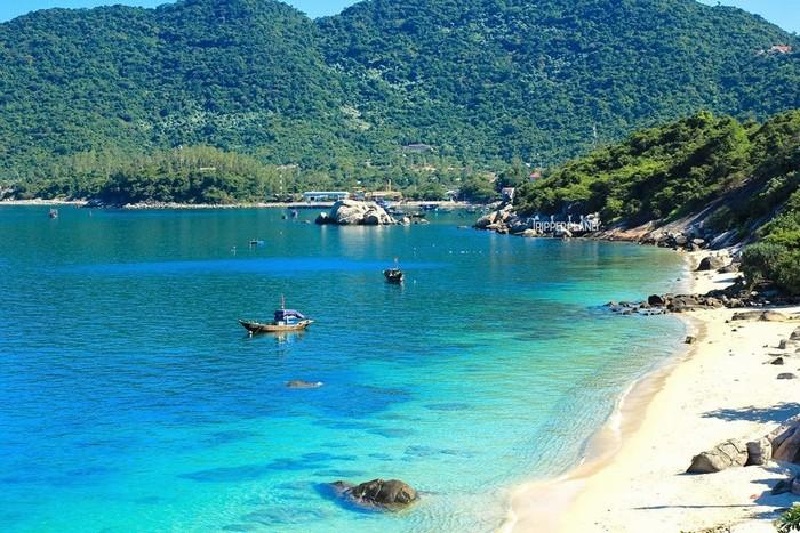
Besides the beauty of the old town, beaches, and traditional craft villages, Hoi An also owns a beautiful, pristine island, Cu Lao Cham. This is also an attractive tourist destination of Hoi An and Da Nang and has been attracting more and more tourists.

Cu Lao Cham has attracted more international visitors to Hoi An 

With many beautiful clear blue beaches, rich flora and fauna, a fresh climate, and many delicious dishes, the experience of traveling to Cu Lao Cham promises to be very interesting. Not only will you be able to swim in the sea, but you will also be able to dive to see the coral with your bare eyes.

Address: Tan Hiep commune, Hoi An, Quang Nam.

20. VinWonders Nam Hoi An

Another extremely famous place that combines sightseeing and fun that visitors should not miss is VinWonders Nam Hoi An. This tourist area is located only about 17km from the center of Hoi An ancient town. Divided into 5 separate areas, this place brings many exciting experiences for all ages.

Tourists and families coming here can comfortably explore the folk island, check in at the intersection, visit the zoo by the river, or enjoy the water park. Thrilling games are also extremely attractive and worth a try.

Address: Vo Chi Cong street, Binh Minh commune, Thang Binh district, Quang Nam.

The secret to a perfect trip to Hoi An

Hoi An is an ancient city that is not bustling, nor does it have high-rise buildings. It's so calm and gentle, but this place always has a strange attraction. Everyone who has come once will never forget it and want to come back a second or third time.

Tourists who come here and want to explore all the tourist attractions here should prepare a schedule of places to go, which points they should go to first, and which points can be conveniently combined along the way to save time.

In addition, visitors should also consider choosing appropriate and economical means of transportation while in the town. The ideal is riding a motorbike. And don't forget to pay attention to when you go, the dry season is always the best time to travel.

How to get to Hoi An?

There are many ways to travel to Hoi An from major provinces and cities. Below are some transportation options when departing to Hoi An from Ho Chi Minh City:

  • Bus: takes about 20 hours and 30 minutes to go from Ho Chi Minh to Da Nang. It will then take another 1 hour to get to Hoi An.
  • Train: takes about 17 hours to go from Ho Chi Minh to Da Nang. It will then take another 1 hour to get to Hoi An.
  • Plane: takes about 1 hour and 20 minutes to go from Ho Chi Minh to Da Nang. It will then take another 1 hour to get to Hoi An.
  • Motorbike: takes about 17 hours and 30 minutes to go from Ho Chi Minh to Hoi An. However, traveling by motorbike is a rather tiring choice. Please stop and rest a few stops if you travel by this means.


Source: www.hoianworldheritage.org.vn

featured-image

Photo: Collected

Hoi An is an ancient town with long-standing cultural values. This place also possesses many poetic landscapes and attractive entertainment spots that are not inferior to Da Nang. If you don't know where to go in Hoi An, these 20 enchantingly beautiful Hoi An tourist destinations will give you an idea to explore.

Hoi An - a world-famous tourist destination

Hoi An is an ancient town in the coastal plain of Quang Nam, located in the lower Thu Bon River. This used to be the largest and busiest commercial port in Southeast Asia. But today, people no longer know Hoi An as a commercial port but as an ancient and attractive tourist city.

Hoi An tourism is attracting more and more tourists to visit, not only Vietnamese tourists but also international tourists coming to explore the old town are increasing. That has helped Hoi An ancient town create a great brand to reach abroad, helping Vietnam's tourism industry attract more and more international tourists.

Source: Collected

Even though right next to Da Nang, it’s far different from the crowded and bustling, worth-living-in city. Hoi An carries within itself the beauty of frozen time with an ancient atmosphere: mossy tiled roofs, streets filled with red lanterns or ancient houses, and architectural works that have existed for hundreds of years.

Hoi An attracts tourists from all over the world. In addition to its ancient features and long-standing relics, its beautiful beaches and traditional villages are also destinations that tourists love. This can be considered a new color for old town tourism, so that anyone who comes here, even once or many times, will not feel bored.

With a diversity of attractions, from ancient houses, assembly halls, and temples, to beaches and craft villages, tourists will have many options to visit and explore, without having to “have a headache” deciding where to go or what to do.

20 Hoi An tourist destinations that tourists should experience (part 1)

To experience all 20 of the most prominent Hoi An tourist destinations, you must come here for 1 or 2 trips. If on one trip, at least 3-4 days should be enough. Because these points are not quite close, some are quite far away from the others.

1. Chua Cau - the spirit of the old town

Known as the spirit and symbol of Hoi An, Chua Cau, also known as the Japanese Covered Bridge, was built by the Japanese in the late 16th century. It is located across a small canal with a unique, delicate design that is a harmonious combination of Vietnamese, Japanese, and Chinese architecture.

Chua Cau - a symbol of Hoi An Accient Town 

Chua Cau is not only a place to learn about the cultural and historical values ​​of Hoi An but is also a poetic sightseeing and check-in spot that "captures" many people's hearts.

Address: At the beginning of Nguyen Thi Minh Khai Street, Hoi An City.

2. Phung Hung ancient house - Impressive Asian beauty

This is also an ancient house mixed with Japanese, Chinese, and Vietnamese architectural styles. Phung Hung ancient house was built in the late 19th and early 20th centuries. After more than 2 centuries, it still retains its original look.

Phung Hung ancient house, hundreds of years old, still retains its ancient beauty

Not only is it a unique tourist destination, attracting hundreds of visitors each year, the ancient house is also a historical witness recognized as a national relic.

Address: No. 4 Nguyen Thi Minh Khai, Hoi An City.

3. Hoai River - a gentle, quiet river

Besides the Covered Bridge Pagoda, the image of the Hoai River is also very familiar to tourists every time they come to Hoi An. Not noisy or violent, Hoai River is gentle and quiet in the heart of the city like the pace of life of indigenous people.

Hoai River is always a photogenic place for your Instagram pictures

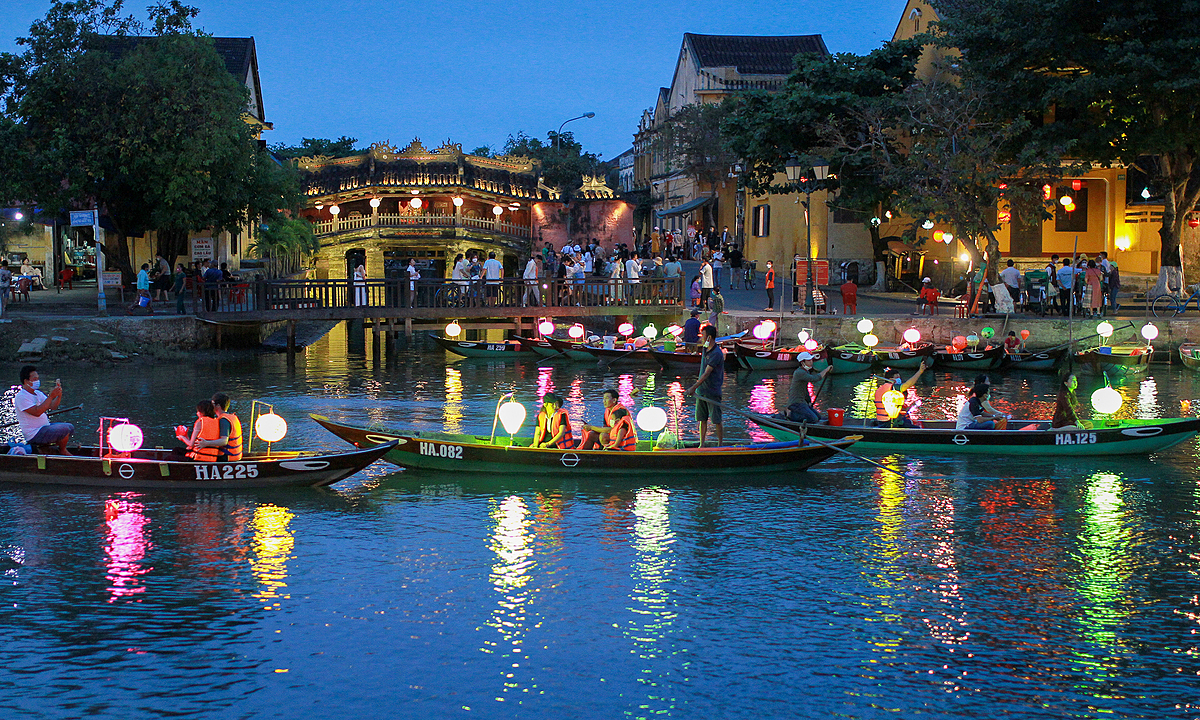
If you have the opportunity, find a corner to sip a cup of coffee and admire the beauty of the Hoai River. Taking a boat trip on the Hoai River, releasing lanterns, and listening to people tell stories is also a very interesting experience. Hoai River is also the place where many extremely chilly vibes photos were born.

4. Hoi An Impression Park - Unique park in the middle of Hoai River

This is a theme park that opened in September 2018. Located on an island in the middle of the Hoai River, quite a few people know about it. But it would be a mistake if you came to Hoi An without visiting this place.

Hoi An Impression Park is suitable for all ages. Inside is a recreational area with many activities such as painting, cooking competitions, games for children, and a food area with countless attractive dishes. Visitors will also easily take captivating photos within the park.

Address: Con Hen, Hoi An.

5. Cantonese Assembly Hall - Hundred-year-old architecture in the heart of the old town

The Cantonese Assembly Hall is located in the center of the old town, a place of religious activities of the Chinese community in Hoi An.

The assembly hall carries with it a majestic beauty

Built in 1885, the assembly hall carries with it a majestic beauty. This place currently preserves many ancient artifacts. At the same time, the Cantonese Assembly Hall is also a venue for organizing lavish festivals for visitors to experience.

Address: 176 Tran Phu, Hoi An City

6. Fujian Assembly Hall - Cultural heritage of the old town

One of the tourist destinations in Hoi An that many tourists visit is the Fujian Assembly Hall. This clubhouse was built in 1967 to pray for good health, good weather, and children.

Fujian Assembly Hall in Hoi An 

Possessing a magnificent beauty with large spaces and unique Chinese architecture, it has been recognized as a cultural heritage. Tourists may take sparkling photos.

Address: 46 Tran Phu, Hoi An City

7. Museum of Trade Ceramics - Unique ceramic museum

Formed in 1995 with the help of Japanese experts, the Mau Yi Ceramics Museum currently holds more than 430 ceramic artifacts dating from the 8th - 18th centuries.

Mau Yi Ceramics Museum currently holds more than 430 ceramic artifacts

These artifacts vividly reflect maritime trade ceramics during the period when Hoi An was still the busiest trading port in Southeast Asia. Visitors to the museum will understand more about the stories of pottery.

Address: 80 Tran Phu, Hoi An City

8. Hoi An Market - World culinary paradise

This is the place where you can both visit and taste all the specialties of the old town and enjoy your life.

Hoi An Market with its iconic yellow color

Different from the tranquility of the old town, Hoi An market is extremely crowded and bustling. Tourists will find countless dishes such as Cao Lau, Quang noodles, sweet soup, and many other items and souvenirs. Especially, the market gate is a super cool photo corner!

Address: 19 Tran Phu, Cam Chau Ward, Hoi An City.

Above are some places tourists should not miss out when coming to Hoi An. In the following section, let's learn about the remaining landscapes on the list, as well as some tips for a complete trip to Hoi An. Stay tuned!


Source: www.hoianworldheritage.org.vn

featured-image

(Photo: TTXVN)


The festival has become an indispensable need in life to satisfy the people's desire to return to their roots, conduct religious activities, balance spiritual life and enjoy and create culture.

Currently, in some localities, precious traditional cultural festivals of ethnic minorities are still preserved.

Khmer people's 'nuggets' festival

Ok Om Bok Festival, also known as the moon worship ceremony or the "nuggets ceremony". Ok Om Bok is the big festival of the year along with the traditional New Year Chol Chnam Thmay, the worship ceremony of Mr. and Mrs. Sene Dolta of Khmer compatriots.

The festival is held at the end of the harvest to show gratitude to the Moon, the god of nature who helps them in protecting crops, regulating the weather, bringing good fruits and fullness.

The Moon God is a god who regulates crops during the year. Therefore, they took glutinous rice into nuggets and other crops to make offerings to the Moon.


Photo: Suc khoe doi song

Featured New Year prayer ceremony of the Dao Tien people

The seasonal prayer ceremony takes place on the first days of the new year, this is one of the social practices associated with the beliefs of the Dao people of Don Phong commune, Bach Thong district, Bac Kan province. Through the festival, the Dao Tien people want to send their thoughts and wishes for good harvests, fruit trees are full of fruit, livestock development ...


Photo: backan.gov.vn

Harrowing bull racing festival in An Giang

This is a traditional festival of Southern Khmer compatriots; is a unique cultural activity in the Seven Nui region, An Giang.

The festival is held annually on the occasion of the Donta holiday of the Khmer ethnic people, which takes place around the end of the 8th and early 9th month of the lunar calendar every year.


Photo: VnExpress

Source: chinhphu.vn

featured-image

Photo: Collected

Hue royal court music is an intangible cultural heritage recognized by UNESCO and a proud cultural and artistic beauty of Vietnam. This is also one of the attractive factors that attract tourists from all over the world to the dreamy city of Hue.

The elegant sound and noble rhythm of Hue royal court music is something that visitors from all over the world will always remember once they have enjoyed it. This is also a proud intangible cultural heritage and a unique form of music and art of Vietnam.

Therefore, traveling to Hue is not only a journey to discover the relics of the Nguyen Dynasty, a dreamy city nestled on the famous Perfume River but enjoying royal court music is also an experience that you should not miss.

1. Introduction to Hue royal court music

Royal court music is a genre of music that dates back to feudal times and is performed for the royal court on occasions such as: Great Court, Regular Court, Te Giao, Te Mieu... The music has elegant lyrics and noble tunes. , nobility contributes to the solemnity of ceremonies. This is also a symbol of kingship and the longevity and prosperity of the dynasty. That's why Hue royal court music was highly respected by Vietnamese feudal dynasties.

Nhã Nhạc Cung Đình là thể loại nhạc có từ thời phong kiến được biểu diễn phục vụ trong cung đình (Nguồn ảnh: vietnamtourism.gov.vn)

Source: Collected

2. When was Hue royal court music recognized by UNESCO?

Hue royal court music was recognized by UNESCO as an intangible cultural heritage and oral literature of humanity on November 7, 2003, and the recognition ceremony was held in Paris, France on January 31, 2004.

This is a great honor and pride for Hue as well as the Vietnamese people. At the same time, this honor also contributes to creating a very unique attraction for the tourism industry of the ancient and poetic city of Hue.

Nhã Nhạc Cung Đình được UNESCO công nhận là di sản văn hóa phi vật thể vào giữa tháng 12/2003 (Nguồn ảnh: Sưu tầm)

Royal court music was recognized by UNESCO as an intangible cultural heritage on November 7, 2003 (Source: Collected)

3. History of the formation of Hue royal court music

According to historical records, Hue royal court music had a process of formation and development in stages through the Ly-Tran dynasties. Successive generations continue to preserve, add creativity, and develop this art form increasingly rich and sophisticated, reaching its peak during the Nguyen Dynasty.

3.1. History of the formation of Nha Nhac (Court Music) through feudal eras

Under Ly Dynasty: Royal court music dates back to the Ly Dynasty (period 1010 - 1225) and began to operate systematically later. At this time, Nha Nhac had elegant lyrics and noble melodies, symbolizing the longevity, prosperity and power of the feudal monarchy.

Nhã Nhạc Cung Đình có từ thời Lý, giai đoạn 1010 - 1225 (Nguồn ảnh: Sưu tầm) 

Royal court music dates back to the Ly Dynasty, the period 1010 - 1225 (Source: Collected)

Under Le Dynasty: Royal court music during the Le Dynasty (period 1427 - 1788) was reserved for the nobility and scholars. The music genre has a complex and tight structure with a clear and detailed organizational scale.

From the Le Dynasty, Nha Nhac was divided into many separate genres such as Giao nhạc, Đại triều nhạc, Miếu nhạc, Đại yến nhạc, Thường triều nhạc, and Cửu nhật nguyệt lai trùng nhạc.

However, at the end of the Le Dynasty, Nha Nhac could no longer maintain its development and began to enter a period of decline and fading due to many different reasons.

Under Nguyen Dynasty: Hue royal court music developed strongly again and was organized systematically during the Nguyen Dynasty (period 1802 - 1945). Especially in the first half of the 19th century, King Gia Long's court knew how to use this scholarly music genre for "spiritual nourishment" when he first established his career in the South.

From here, Nha Nhac was closely associated with the Hue royal court and developed according to a standard, systematic, and methodical model with hundreds of musical pieces. This period was also an important preparation step, creating a premise for the development of Royal Music through the following kings.

Hình ảnh Nhã nhạc cung đình Huế vào triều Nguyễn (Nguồn ảnh: Sưu tầm)

Images of Hue royal court music during the Nguyen Dynasty (Source: Collected)

3.2. Hue royal court music today

Today, Hue royal court music with forms such as orchestra, songs, songs, and dances is performed on many occasions such as Hue Festival, Buddhist festivals, folk festivals, and chamber music.

Court music is also performed in diplomatic ceremonies, performed for tourists and local people during holidays and traditional Tet holidays. Therefore, today's court music still has the occasion and space to perform. Artistic value is still preserved, lasting, and continues to be promoted.

If you have the opportunity to come to Hue, do not miss the opportunity to enjoy and feel royal court music through unique performances in addition to discovering the beauty of the ancient capital and specialties.

nha nhac cung dinh hue

Today's court music still has rich performance conditions and space (Source: Collected)

4. Some information about Hue royal court music

4.1. Where to watch Hue royal court music?

  • Hue royal court music on the Perfume River

This is a familiar address chosen by many tourists to enjoy Hue royal court music. Tourists will buy tickets to board the dragon boat, walk around the romantic Perfume River, and enjoy Nha Nhac and other music genres performed by singers.

Nhã nhạc cung đình Huế trên sông Hương (Nguồn ảnh: Sưu tầm)

Hue royal court music on the Perfume River (Source: Collected)

  • Duyet Thi Duong

Duyet Thi Duong is the first theater to open for performing court music, built during the Nguyen Dynasty, nearly 200 years ago. This is also one of the oldest performance spaces in Vietnam and a place to perform many art genres such as opera, dance, and court music for the king's inner palace. Coming to Duyet Thi Duong, visitors will be truly impressed with the majestic, solemn space and sacred atmosphere.

4.2. How much is a ticket to see Nha Nhac? When is the performance?

Estimated ticket price: 100,000 VND

Scheduled time:

  • At Huong River: 18:00, 19:00 or 20:00
  • At Duyet Thi Duong: 10:00 – 10:40 and 15:00 – 15:40

Hue royal court music is a priceless intangible asset and the pride of the Vietnamese people and the people of the ancient capital. Tourists should at least once come to the dreamy land of Hue and enjoy the Royal Music program to feel and absorb the essence of the music genre imbued with national identity.

5. How to get to Hue?

As a tourist city, the choice of transportation to Hue is also extremely diverse. From big cities like Hanoi and Saigon, you can take a plane to Hue in only 1 hour and 30 minutes. There are also bus routes from all provinces to Hue, however, the travel time will be much longer. We recommend traveling by plane to save time for fun activities in Hue, as well as get the best experience.


Source: Vinpearl.com

Page:
...
29
...